

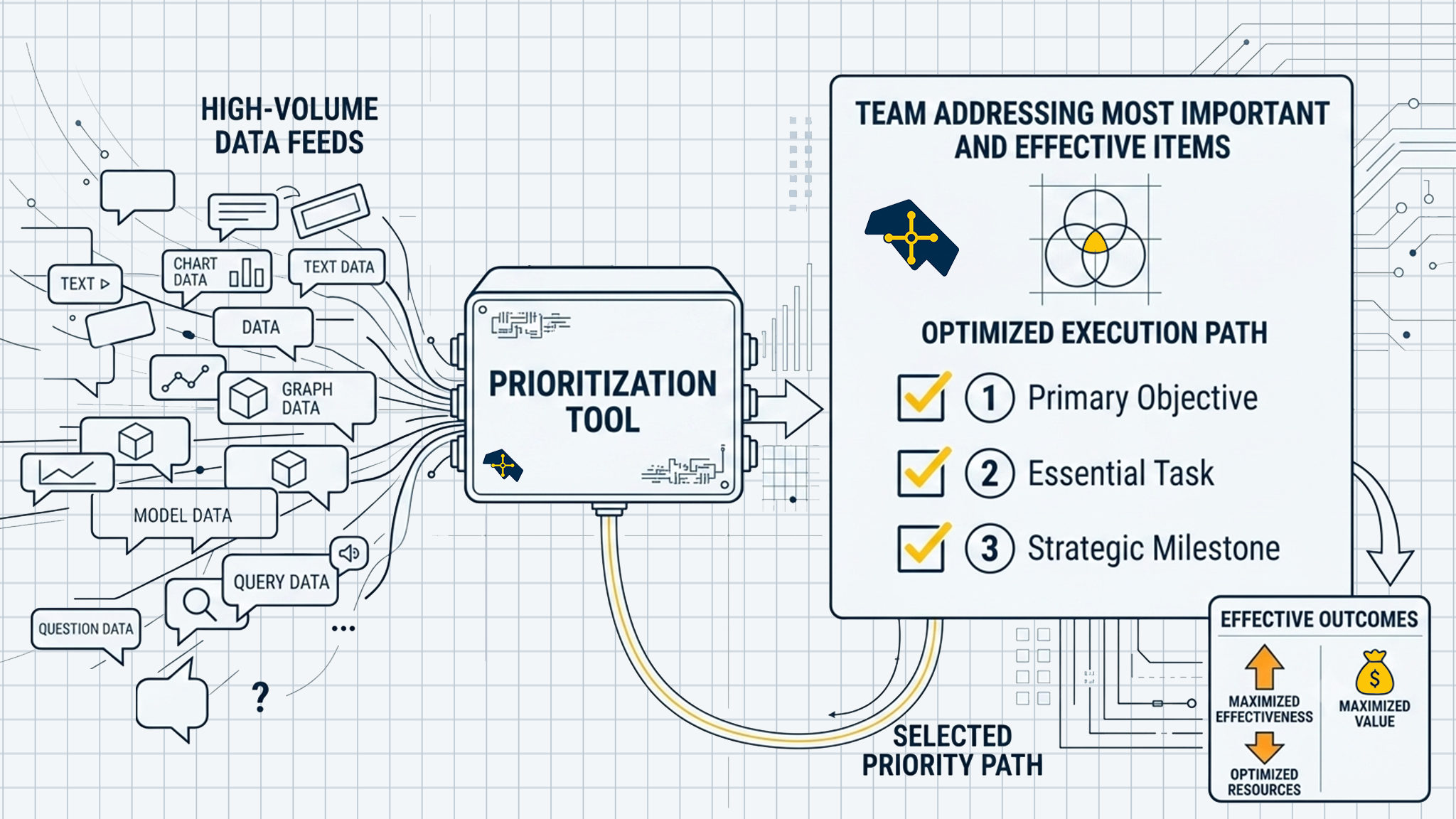
Pareto Analysis is a prioritization method based on a simple observation:
- A minority of causes often drives a majority of outcomes.
- In practice, you’ll often find that ~80% of complaints come from ~20% of issue types.
You don’t use Pareto to ignore the remaining issues, you use it to sequence work so the team earns the biggest satisfaction gains early.
When to use it
Use Pareto when:
- you have a lot of requests, feedback, tickets, or defects and limited capacity
- you need a defensible way to decide “what to fix first”
- stakeholders disagree on priorities and you want an evidence-based approach
Be careful when:
- one issue is low-frequency but high severity (security, safety, compliance). Pareto is a prioritization tool, not a risk model.
Step-by-step: Pareto Analysis
Step 1) Collect feedback and define the “unit” you’ll count. Decide what you’re counting:
- support tickets
- app store reviews
- survey responses
- churn reasons
- defect reports
Tip: Pick one timeframe (e.g., last 30 days) so you’re not mixing old and new realities.
Step 2) Categorize feedback into issue types
Create a small set of categories that match how your product/service works. Examples:
- Delivery & fulfillment
- Payments & billing
- Performance (loading time)
- UX / usability
- Reliability (crashes)
- Account access / passwords
If categories are too broad, you’ll lose signal. If they’re too narrow, you’ll dilute signal.
Step 3) Quantify: count frequency (and optionally weight severity) Start simple:
- Frequency = number of times the issue shows up
If needed, add a light severity weighting
- Critical = 8
- High = 4
- Medium = 2
- Low = 1
Then compute a weighted score:
- Weighted Impact = frequency × severity weight
Step 4) Build the Pareto view: sort from biggest to smallest
- Sort categories by frequency (or weighted impact) descending.
- Compute cumulative percentage.
This will show you the “knee” in the curve: the point where the biggest categories stop dominating.
Step 5) Prioritize actions: “vital few” first
Pareto helps separate:
- the vital few problems that deserve immediate attention
- the trivial many that can be scheduled later
Rule of thumb: pick the top 1–3 categories to start.
Step 6) Implement changes, then measure impact
After changes, measure:
- customer satisfaction indicators (CSAT/NPS)
- complaint volume per category
- conversion metrics (if relevant)
- incident/defect trends
Then repeat the loop—feedback changes after you fix the biggest issues.
Example
Software Feedback → performance beats, UI redesign (when data says so)

Situation: A friend’s software company was receiving an increased amount of feedback after a redesign went to production. The obvious culprit was the new interface making things confusing for the user base that were not identified during UAT, however, after we established a set categories for all these requests coming in at the same time, the issue with the new UI was not the main driver, what we found was unexpected.
Pareto finding: ~80% of complaints were about loading speed.
Decision: prioritize performance improvements over a UI redesign.
Actions:
- performance profiling (largest pages/flows)
- optimize database queries / caching
- reduce payload size (images, bundles)
- address top endpoints by latency
Why it worked: it addressed the dominant pain first, even though the UI issues were still real. We gave ourselves time to address the update workflows without having every user mad at our app.
Measurable outcomes: As with everything we do, measuring is important. Once the fixes were in place we measured the changes in these three metrics we picked (Median page load time, Ticket volume, Conversion Percentage)
Our conclusions (in the form of a template):
- “Median page load time decreased from <X>s to <Y>s”
- “Ticket volume tagged ‘slow’ dropped by <X>%”
- “Conversion/retention improved by <X>%”
A simple checklist you can reuse
Final takeaway
Pareto Analysis is an efficient way to turn large volumes of feedback into a focused improvement plan. By concentrating on the few issues that drive most complaints, you can deliver meaningful gains faster and build a culture of continuous, evidence-based improvement.


Leave a Reply