

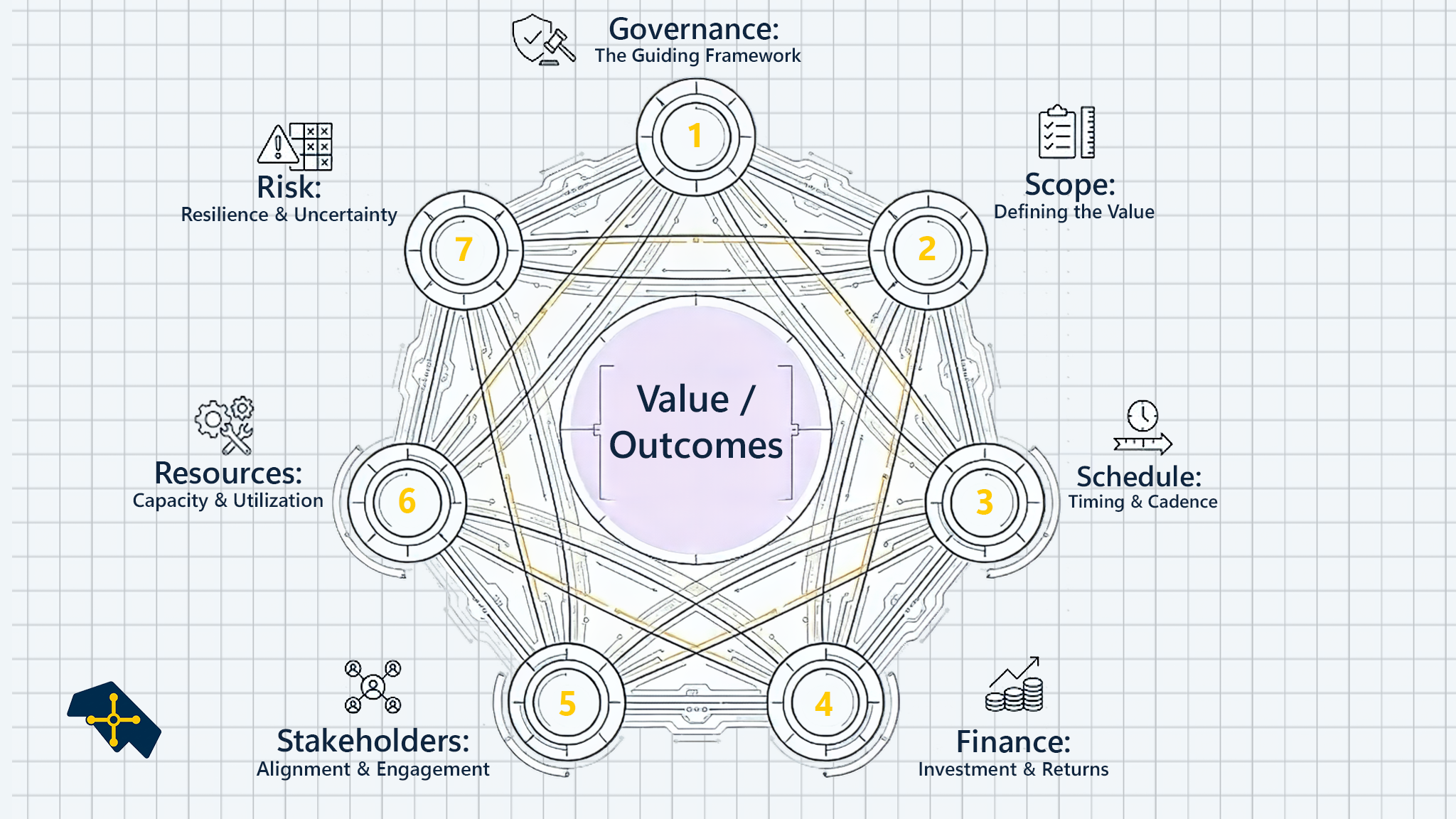
Project performance domains are one of those concepts that sit quietly underneath everything in modern project management: they’re not a “method,” but they often determine whether the work is coherent, repeatable, and value-realizing.
I’m writing this from the perspective of a program manager in high‑stakes engineering (MedTech and other regulated environments). I started learning with PMI in 2009 and I’ve been a PMI member since 2011. In this article, I’ll give you a coherent end‑to‑end view of how PMI’s current framing fits together in practice. The goal is to make the tradeoffs between scope, schedule, money, people, and uncertainty visible so teams can stay aligned to outcomes and value.
A central shift in PMI’s latest framing is the move from managing delivery mechanics to managing value delivery. I explore that shift through the project performance domains: a connected system of behaviors and decisions that run in parallel across predictive, adaptive, and hybrid environments.
🧭 TL;DR The 7 project performance domains are a value delivery system: an integrated set of behaviors and decisions that operate in parallel to keep a project aligned to intended value while navigating people, uncertainty, and delivery constraints.
🔑 Source note: Terminology follows PMI’s performance-domain framing (PMBOK Guide, 8th Edition)

How to read this article
- What changed in PMI’s framing (value delivery): PMI shifts attention from “delivery mechanics” to whether work produces outcomes and realized value.
- The 7 domains are: Seven always-on project “control surfaces” (Governance, Scope, Schedule, Finance, Stakeholders, Resources, Risk) that constrain and shape each other.
- How to use them: When anything changes mid-flight, run the 60-second loop to re-anchor value and make tradeoffs explicit.
- Domain deep dives: Each domain includes what it is, why it matters, and failure patterns that break value delivery.
- The MedTech lens: A regulated overlay mapping domains into QMS realities (objective evidence, traceability, V&V gates, and change control).
Domains interact

As a program manager I have gone through a long list of project issues, when they come knocking your way remember this simple formula (1) anchor them to governance and value, (2) engage stakeholders, and (3) make tradeoffs explicit across scope/schedule/finance/resources/risk.
Manage Change – 60 second loop
When something changes mid-flight. Think of a change request, a slip, a quality signal, a stakeholder conflict, then proceed to run this quick diagnostic loop:
- Trigger: Name the event clearly (what happened, and what changed?).
- Re-anchor: Reconfirm Governance + Value (what decision needs to be made, and what “value” means here?).
- Assess impact: Scan the ripple effects across Scope / Schedule / Finance / Resources / Risk.
- Re-align: Bring Stakeholders back into a shared understanding (expectations, tradeoffs, and decision rationale).
- Decide: continue / pivot / pause / stop.
- Record + update: Capture the decision, then update baselines and plans as appropriate.
This turns the domains into an executable routine: a way to stay coherent under change, not just a set of concepts to memorize.
Systems for value delivery

One of the most useful ideas in the latest PMI framing is the explicit shift from delivery mechanics to value delivery. In practice, that means:
- Projects sit inside a broader organizational system (strategy, governance, operations, products, portfolios/programs).
- The purpose of project work is not only to produce outputs, but to enable outcomes, the changes that create benefits (and sometimes disbenefits).
- Good management decisions continuously test whether the project is still the right investment given new information.
Value Chain
When you’re deciding whether you’re finished with your work or simply what to do next and what to stop doing, use this simple ladder:
- Outputs: what the team produces (deliverables, artifacts).
- Outcomes: what changes because of those outputs (behavior, capability, performance). There is always a managed transition between Outputs and Outcome, historically that transition was often treated as out-of-scope for projects, in PMI’s current framing it is now the key for value delivery.
- Benefits / disbenefits: the positive and negative effects that follow from those outcomes. There needs to be a good system in place to measure these.
- Value: the net worth of those effects relative to the investment (financial and nonfinancial).
If a project is “on track” but outcomes are not being realized (or disbenefits are growing), you’re usually looking at a governance + stakeholder + scope problem, not a scheduling problem.
Operationalize Outcomes
A helpful way to read the latest PMI ideas is that it takes a stance on what “done” really means. In earlier framings, a project could feel complete once a product, service, or result existed. A project is anchored in a unique context and an intended outcome shift. That context (constraints, stakeholders, adoption environment, risk appetite, regulatory reality, operating model) determines whether outputs will ever translate into outcomes.
Start with the input: a strategic baseline, a vision, and authorized intent. Then, instead of letting that intent dissolve into a backlog of deliverables, keep an “outcome anchor” in view: What change must be realized in the organization for the work to be worth it? That’s where benefits and value enter the story.
From Delivery to Managed Transition
The transition is real work that must be managed. In the current PMI’s project model, execution is shaped by three connected layers:
- Governing principles (6): a decision mindset that keeps teams honest
- Performance domains (7): the concurrent control surfaces where tradeoffs are made
- Focus Areas (5): the recurring modes of work that help you revisit decisions as reality changes.
Two principles that I see are the key to the new way of thinking:
Adopt a holistic view: the project is not just shipping deliverables. It includes the downstream operating conditions required for adoption (for example, Sales and Support actually using the capability in production).
Focus on value: measure real change (ROI, stakeholder value, performance lift, risk reduction), not just completion rates.

Outcome realization is as an active transition that includes tailoring, adoption, and systems change. At the output you are not finished, you need to transition what you built into operations. That transition shows up as:
OUTPUT (what you build)
+
MANAGED TRANSITION
=
OUTCOME (organizational capability)
If your plan has a crisp output definition but a vague transition plan, you’re betting that benefits will appear by magic. The PMI’s current structure is a way to make that bet explicit and manage it. This is key for projects to actually deliver their intended value.

The transition from process-group thinking to outcome-focused domains reflects a real-world truth: projects succeed or fail less because a team “followed the next step,” and more because the team made the right decisions under constraints, uncertainty, and competing stakeholder needs.
Historically, many frameworks emphasized “efficient delivery within constraints” (scope, schedule, cost). Today, project management is expected to address the project’s value proposition, disbenefits, adoption, and alignment to organizational strategy.
The 7 Domains
In PMI’s performance-domain framing, the seven domains are the major “control surfaces” of the system:
- Governance: oversight, decision rights, escalation paths, and strategy alignment
- Scope: defining the value and the boundaries of work (vision → roadmap → release → iteration)
- Schedule: timing and cadence of delivery to optimize time-to-value
- Finance: investment, cost thresholds, and whether the work remains justified
- Stakeholders: alignment, trust, and engagement of those affected by outcomes
- Resources: capacity, team enablement, and physical assets; how work gets done
- Risk: uncertainty, threats, and opportunities that can protect or enhance value
In my experience, most “single-domain” problems are actually system problems. The project manager’s leverage is making tradeoffs explicit, visible, and value-aligned. Go over the following section to understand what I mean about the ripple effect between domains and have a handy structure to assess.
Tailoring
How to apply the domains in predictive, adaptive, and hybrid delivery. The most common failure mode with “best practices” is using them as if context doesn’t matter. Let’s go over a quick tailoring approach:
- Choose an initial development approach (predictive, adaptive, hybrid) based on uncertainty, regulatory needs, and cadence of learning.
- Tailor for the organization (governance, policies, risk appetite, procurement constraints, operations readiness).
- Tailor for the project (stakeholder complexity, criticality, novelty, technology, team distribution).
- Improve continuously (treat your approach as a hypothesis; adjust using feedback).
Tailoring is not “skipping steps”; it’s making tradeoffs explicit and defensible. The best tailoring choices reduce rework and protect value under uncertainty.
- Predictive-heavy: strengthen baselines, change control, verification/ validation and phase gates.
- Adaptive-heavy: strengthen product vision, backlog discipline, feedback loops, and lightweight governance.
- Hybrid: define which parts are “fixed” (e.g., compliance constraints) and which are “variable” (e.g., features, sequencing). See: our recommended approach of MedTech and other safety-critical industries Aligning-Agile-and-non-Agile-teams.
🔑 Key takeaways (Tailoring)
- Tailoring is not “skipping steps”; it’s making tradeoffs explicit and defensible.
- The best tailoring choices reduce rework and protect value under uncertainty.
Domain deep dives
Below, each domain includes (1) what it is, (2) why it matters, and (3) the high-probability mistakes that break value delivery.
Governance (the guiding framework)

Governance provides the structure for oversight: decision rights, escalation paths, priorities, and who approves what. In regulated engineering, governance is where you enforce evidence, traceability, change control, and accountability.
At a practical level, governance is the decision system of a project:
Governance
=
decision rights
+
transparency
+
control thresholds
That system rarely lives inside the project alone, it is nested in broader organizational oversight and connects to:
- Strategic alignment: are we still building the right thing?
- Portfolio/program priorities: funding and sequencing across competing initiatives
- Risk & compliance boundaries: what cannot be compromised
- Change control: how decisions are approved, traced, and communicated
- Quality standards: what “acceptable” actually means (and what evidence proves it)
Why governance is the “hub” domain
Governance drives (and is driven by) the other domains:
- Scope: defines boundaries for controls (what changes require approval and impact analysis)
- Stakeholders: legitimacy, escalation paths, transparency, trust
- Resources/Schedule: authority to allocate capacity and approve tradeoffs
- Finance: budget thresholds, release of funding, and continue/pivot decisions
- Risk: dictates risk appetite and whether opportunity capitalization is acceptable
❗ Warning (Governance): Governance fails when it becomes either bureaucracy without purpose or informality without accountability. Both destroy alignment: one by slowing decisions without improving outcomes; the other by letting scope, risk, and spending drift without clear ownership.
Scope (defining the value)

Scope is not just “requirements.” It’s how you define the value boundary and maintain focus as information changes. A practical mental model is the planning stack:
Vision → Roadmap → Release → Iteration
Scope is healthiest when it is anchored in value, not in activity. Many scope problems are really unclear value boundaries: the team is busy, but the “why” is fuzzy, so the “what” keeps moving. A practical alternative to starting with a WBS: invert it and start with outcomes.
Instead of a Work Breakdown Structure (WBS) as your primary framing, use a Value Breakdown Structure (VBS) to define boundaries without pretending you can predict everything up front.
Value Breakdown Structure (VBS) a stable-to-flexible ladder
- Level 1 Strategic theme (rigid): the business goal that should not drift
- Level 2 Value drivers (stable): measurable outcomes required to hit the goal
- Level 3 Expected benefits (flexible): what users/business will experience if outcomes are realized
- Level 4 Capabilities (fuzzy): high-level features/systems needed (your initial scope hypothesis)
Scope health KPI (program-level closure / retrospective)
One way to check whether scope definition stayed coherent:
Scope Definition Accuracy (%) = Delivered planned scope / Total planned scope × 100
When this number is low, it’s rarely because the team didn’t work hard. It’s usually because the boundary wasn’t stable enough to build and verify.
❗ Warning (Scope): Finished ≠ Accepted ≠ Adopted. A deliverable can be technically “done” and still fail to create value if it is not accepted by stakeholders or adopted by operations.
Schedule (timing & cadence)

A schedule is not a Gantt chart. A schedule is a theory of how value will arrive over time.
In that sense, delivery cadence becomes a strategy: it shapes feedback loops, risk exposure, integration effort, and time-to-value. And your schedule baseline is the approved version of the schedule model, the reference that tells you whether your strategy is working, or whether you’re drifting.
Then there’s your development approach, usually a balance between predictive (upfront planning) and adaptive (iterative/agile).
A practical definition
𝗦𝗰𝗵𝗲𝗱𝘂𝗹𝗲
=
𝗰𝗮𝗱𝗲𝗻𝗰𝗲
+
𝗯𝗮𝘀𝗲𝗹𝗶𝗻𝗲
+
𝗮𝗽𝗽𝗿𝗼𝗮𝗰𝗵
1) Delivery cadence (your feedback + risk strategy)
Single, multiple, periodic, or continuous delivery. Cadence shapes feedback speed, risk exposure, integration pain, and time-to-value.
| Delivery cadence | Description | Strategic fit |
|---|---|---|
| Single Delivery | One major release at the very end of the project. | Traditional construction, large infrastructure, or highly regulated environments. |
| Multiple Deliveries | The project has several distinct components delivered at different times. | Building a hospital campus where separate buildings open sequentially. |
| Periodic Delivery | Deliveries happen on a fixed, recurring schedule (e.g., monthly, or at the end of a sprint). | Agile software development, marketing campaigns. |
| Continuous Delivery | Deliveries happen constantly, immediately as features are completed. | Cloud-based software (SaaS), digital platforms. |
2) Schedule baseline (your learning reference)
The approved version of the schedule model.
When you don’t have a baseline, you can’t tell if you’re learning… or drifting.
3) Development approach (how you handle uncertainty)
Predictive (upfront planning), adaptive (iterative/agile), or hybrid.
The choice should match uncertainty, constraints, and the organization’s ability to absorb change.
Closely linked constraints reminder
- Expand scope → schedule pressure rises
- Cut budget → schedule pressure rises
- Compress time → quality/risk often surface later
If you want a reliable schedule, don’t only manage dates. Manage the tradeoffs.
- 𝘋𝘦𝘭𝘪𝘷𝘦𝘳𝘺 𝘤𝘢𝘥𝘦𝘯𝘤𝘦 is a 𝘀𝘁𝗿𝗮𝘁𝗲𝗴𝘆 that shapes feedback, risk exposure, and time-to-value.
- 𝘚𝘤𝘩𝘦𝘥𝘶𝘭𝘦 𝘣𝘢𝘴𝘦𝘭𝘪𝘯𝘦 is the 𝗮𝗽𝗽𝗿𝗼𝘃𝗲𝗱 version of the 𝘀𝗰𝗵𝗲𝗱𝘂𝗹𝗲 𝗺𝗼𝗱𝗲𝗹. That is how you learn how your strategy is working.
- D𝘦𝘷𝘦𝘭𝘰𝘱𝘮𝘦𝘯𝘵 𝘢𝘱𝘱𝘳𝘰𝘢𝘤𝘩, nowadays this is usually a balance between 𝘱𝘳𝘦𝘥𝘪𝘤𝘵𝘪𝘷𝘦 (upfront planning) and 𝘢𝘥𝘢𝘱𝘵𝘪𝘷𝘦 (iterative/agile)
A practical definition to capture this domain is:
Schedule is about timing the flow of value. Predictive milestones and adaptive cadences are both valid; the key is choosing a cadence the organization can absorb and that optimizes time-to-value.
❗ Warning (Schedule): A schedule slip is rarely “just time.” It usually exposes hidden constraints (capacity, risk, dependency friction, stakeholder misalignment) that must be addressed systemically, not only by “working harder.”
Finance (investment & returns)

Finance covers investment, cost thresholds, and whether continuing still makes sense. In value delivery, finance is not only tracking spend, it is decision support: continue / pivot / pause / stop.
One of the most common finance breakdowns is mistaking reporting for decision support. The goal is not to know the numbers; the goal is to use them to trigger the right decisions at the right moments (go/no-go, phase gates, funding release, scope tradeoffs, and risk responses).
A practical definition
Finance
=
investment logic
+
control thresholds
+
value tracking
Investment logic (why this project exists)
This is the “selection story” that explains why this is a good use of resources instead of something else. It is usually expressed through measurable methods such as:
- NPV: current value of future cash flows
- ROI / IRR: profitability and annualized return
- Payback period: time to recover the initial investment
- Opportunity cost: what you give up by choosing Project A over Project B
But in practice, your value case also includes nonfinancial outcomes (safety, quality, compliance posture, customer trust, strategic positioning). This is especially true in regulated environments where “return” can include risk reduction and audit readiness, not only margin.
Control thresholds (when money forces a decision)
Healthy project finance has explicit thresholds, for example:
- Approval thresholds: who must approve additional spend (and what evidence is required)
- Change-cost thresholds: when a scope change requires budget re-baselining
- Reserve usage rules: when management reserve or contingency is released
- Stop-loss rules: what signals justify pausing/stopping to avoid sunk-cost drift
Value tracking (how you know the strategy is working)
Finance becomes “deep” when it connects performance signals to decision actions:
- Baseline vs. actual vs. forecast: not just what happened, but what is now likely to happen (estimate-at-completion thinking)
- Earned Value (EV) as a control mechanism: tying progress to the cost and schedule baselines (so “% complete” becomes auditable)
- Cashflow timing matters: funding gates and spend timing can become constraints just like schedule dependencies
- Cost of quality is real: prevention/appraisal costs versus failure costs (and the financial shape of rework)
Two realities finance makes explicit
- Time matters: value is a curve, not a point (fixed costs, cost baseline, break-even threshold, path to positive return). Projects don’t “finish” financially, they cross thresholds.
- Measurements are not vanity: metrics exist to change decisions. If the numbers don’t trigger actions, finance is just storytelling.
Finance process loop
- Plan financial management (how decisions will be made)
- Estimate costs (and uncertainty ranges)
- Develop budget (baseline + reserves)
- Monitor & control finances (forecasting + decision triggers)
Deep dive (next): I’m creating a follow-up article dedicated to project finance, how to build a defensible value case, set decision thresholds, forecast, and use EV/benefits logic without turning finance into bureaucracy.
❗ Warning (Finance): Projects fail financially when teams treat budgets as reports instead of decision triggers, or when sunk cost fallacy replaces objective assessment.
Stakeholders (alignment & engagement)

Stakeholder engagement is trust-building and alignment: ensuring the right people are involved early, expectations are realistic, and decisions are understood.
A sharp way to remember why stakeholders are a “performance domain” (not a soft skill) is this:
Stakeholders don’t merely support projects. Stakeholders define whether the project creates value.
A practical definition
Stakeholders
=
value perception
+
active engagement
The mechanics: two tracks that must run together
- Track 1 Engagement: Plan → Manage → Monitor engagement
- Track 2 Communications: Plan → Manage → Monitor comms
In practice, the project sits inside a stakeholder network: customers, sponsors, team members, partners, regulators, competitors, and community. Ignoring any one of these can surface later as rework, delays, or rejection.
Acceptance criteria is the trust mechanism
The PM’s job is to build trust through shared, testable acceptance criteria. “Broadcasting updates” is not engagement; engagement is participation + alignment.
How to validate engagement is real
- NPS / satisfaction signals (where appropriate)
- Periodic alignment interviews (short, structured check-ins on expectations, tradeoffs, and acceptance)
❗ Warning (Stakeholders): Stakeholder satisfaction ≠ doing everything requested. Doing everything is usually a governance failure that trades long-term value for short-term appeasement.
Resources (capacity & utilization)

Resources includes people, skills, tools, and physical assets. In knowledge work, performance depends on psychological safety, clear team agreements, and removing impediments.
Resources includes people, skills, tools, and physical assets. In knowledge work, performance depends on psychological safety, clear team agreements, and removing impediments.
Many delivery problems that show up as “delays,” “defects,” and “burnout” are early signals of resource-system failure: not enough capacity, wrong competencies, or missing enablement.
A practical definition
Resources
=
capacity
+
competency
+
enablement
The systemic dynamic is blunt
Resource bottlenecks extend duration and elevate execution risk.
If you want predictable delivery, don’t ask people to “try harder.” Ensure the team has what it needs to produce evidence, quality, and flow; then protect capacity (especially from chronic overutilization and context switching).
One useful reminder for complex work: teams own deliverables and outcomes, not just tasks. Resourcing should be planned around outcome ownership (and the constraints that come with it).
❗ Warning (Resources): Overutilization looks efficient but causes queueing, context switching, and defects. In regulated environments, it also undermines evidence quality and increases compliance risk.
Risk (resilience & uncertainty)

Risk is the navigation of uncertainty: threats to mitigate and opportunities to enhance. In regulated engineering, proactive risk work is the difference between controlled delivery and reactive fire-fighting.
Risk is not a document. Risk is how you steer under uncertainty and it takes experience to both mitigate threats and exploit opportunities.
A practical definition
Risk = protect value (threats) + enhance value (opportunities)
A simple maturity check
- Robust risk reserves (schedule and finance) exist and are maintained
- The risk register/file is continuously integrated into decision-making
If the risk register is updated “at the end,” you don’t have risk management. You have documentation.
❗ Warning (Risk): Risk fails when it becomes a one-time document. Uncertainty is dynamic; risk identification, analysis, and response must be continuous and tied to decisions in scope, schedule, and finance.
🩺MedTech Lens

In a MedTech company, the domains operate inside a Quality Management System (QMS). The “extra layer” isn’t bureaucracy—it’s the set of controls that makes delivery traceable, defensible, auditable, and sustainable.
Below is the QMS layer you typically need for each domain.
1) Governance → management accountability + decision rights
What this means in MedTech: management review, quality objectives/metrics, documented decision rights (who can approve requirements, changes, releases), escalation paths, and audit-ready evidence of decisions.
QMS Layer:
- Management review cadence: recurring forums where leaders review progress, risk, and quality signals (not just schedule).
- Quality objectives & metrics: a small set of leading indicators tied to safety/effectiveness/compliance (e.g., defect trends, CAPA aging, verification coverage, complaint signals).
- Documented decision rights (RACI / approval matrix): who can approve requirements, changes, releases, risk acceptability, and exceptions.
- Escalation paths + thresholds: clear triggers for escalation (e.g., major nonconformity, missed evidence gate, budget threshold, residual risk change).
- Audit-ready evidence: minutes/records that show the decision, the rationale, the evidence reviewed, and the approvals (so you can defend it later).
Insight: In MedTech, “moving fast” is rarely blocked by process, it’s blocked by unclear decision rights and missing evidence. Good governance reduces rework by making “what good looks like” explicit before the team builds.
2) Scope → design controls + traceability system
What this means in MedTech: scope isn’t “what’s in the backlog.” It’s the regulated definition of the intended use + requirements boundary and the discipline to keep that boundary stable enough to verify, validate, and defend.
QMS Layer:
- Intended use / intended purpose framing: the anchor for what must be safe/effective (and what is explicitly out-of-scope).
- Requirements discipline: clear hierarchy (user needs → system/software requirements), unambiguous wording, and acceptance criteria.
- Bidirectional traceability: user needs ↔ requirements ↔ design ↔ tests (V&V) ↔ release; maintain trace links as changes occur.
- Change-impact analysis: documented assessment of how changes affect risk, verification, validation, labeling, training, and regulatory commitments.
- Controlled scope decisions: “yes” decisions include what evidence must be updated (not just what code changes).
Insight: In regulated work, uncontrolled scope is not just “scope creep” it is evidence debt. The fastest teams treat every scope change as a traceability + risk decision, not as a negotiation.
3) Schedule → evidence plan + gate readiness
What this means in MedTech: your schedule is not just “feature delivery.” It’s the timing of evidence creation, reviews, approvals, and readiness gates. In other words: delivery cadence is constrained by time-to-evidence.
QMS Layer:
- Evidence plan integrated into the master schedule: verification/ validation activities, documentation, reviews, and sign-offs are first-class tasks.
- Approval lead times explicitly modeled: Quality/Regulatory/Clinical review cycles, supplier lead times, tool validation, and change-control throughput.
- Release readiness gates: criteria-based gates (requirements baseline, V&V completion, risk acceptability, labeling/training readiness).
- Definition of “done” includes evidence: a feature is not done until its planned objective evidence is produced and reviewed.
- Buffering for re-test / re-validation: plan for iteration caused by defects, nonconformities, or change requests.
Insight: Many “schedule slips” are actually evidence bottlenecks (reviews, test capacity, unstable requirements). Fixing the schedule usually means fixing the evidence system, not asking the team to work harder.
4) Finance → cost of quality + compliance investment
What this means in MedTech: finance is not “tracking spend.” It is deciding what you will fund to achieve safe, effective, compliant outcomes. This includes the often-hidden costs of quality and regulatory readiness.
QMS Layer:
- Explicit “cost of quality” budgeting: verification, documentation, test environments, external labs, clinical work, and quality engineering time.
- Compliance investment line items: tool validation, audits, supplier quality, cybersecurity activities, and regulatory submissions where applicable.
- Decision triggers beyond ROI: thresholds that consider risk reduction, compliance posture, and patient/user impact (not just margin).
- Funding that matches cadence: ensure cashflow supports gate readiness and avoids “end-loaded” quality work.
- Financial transparency for change: quantify the incremental cost of evidence when scope changes (re-test, re-validation, documentation updates).
Insight: Underfunded quality work creates a predictable pattern: teams “save money” early and pay it back later as delays, remediation, and quality events. Good finance governance funds evidence early.
5) Stakeholders → cross-functional sign-off + external constraints
What this means in MedTech: stakeholders aren’t just “people to inform.” They are the owners of acceptance criteria for safety, effectiveness, manufacturability, serviceability, and compliance.
QMS Layer:
- Cross-functional alignment early: Quality/Regulatory/Clinical, Manufacturing, Service/Operations, Security/Privacy as applicable.
- Explicit sign-off points: what must be approved at requirements baseline, design review, V&V readiness, and release.
- Shared understanding of evidence expectations: what “objective evidence” looks like for each key claim/requirement.
- Residual risk agreement: who accepts residual risks and under what rationale (and how that rationale is documented).
- External constraints mapping: notified bodies, standards, suppliers, and audit timing—treated as schedule and scope constraints, not surprises.
Insight: In regulated delivery, stakeholder conflict often shows up late as “rework.” The cure is to convert stakeholder expectations into testable, reviewable evidence agreements early.
6) Resources → competency, training, and controlled tools
What this means in MedTech: resources are not just headcount. You need the right competencies, time, and controlled tooling to produce objective evidence consistently.
QMS Layer:
- Competency model by role: what skills are required (systems, software, verification, risk, cybersecurity, clinical, quality).
- Training records + onboarding: demonstrable training for processes/tools that affect quality; keep records audit-ready.
- Controlled/validated tools where required: ensure tooling used for design, build, test, and release meets validation/control expectations.
- Protected capacity for evidence work: documentation, reviews, trace updates, and test execution are planned time—not “after hours.”
- Independent verification capacity: avoid overloading the same people with building and validating in ways that reduce objectivity.
Insight: Overutilization degrades evidence quality not just slowing delivery. In regulated work, quality of evidence is a deliverable with its own capacity needs.
7) Risk → ISO 14971-style risk management integrated with delivery
What this means in MedTech: risk goes beyond a document you finish. It’s the decision logic that connects hazards to requirements, design controls, verification, and post-market monitoring.
QMS Layer:
- Living risk file tied to delivery artifacts: hazards ↔ hazardous situations ↔ harms ↔ risk controls ↔ requirements ↔ tests.
- Risk acceptability criteria: clear thresholds and rationale; define who can accept residual risk and how it is documented.
- Verified risk controls: risk controls are not “implemented” until verified (and validated when appropriate).
- Trigger-based monitoring: define signals that indicate risk is changing (complaints, deviations, near-misses, cybersecurity signals).
- Closed-loop actions: CAPA/change control mechanisms so risk discoveries feed back into scope, schedule, and finance decisions.
Insight: Teams “feel safe” when risk is up to date. Regulators (and auditors) trust you when risk is traceable to evidence and connected to real-world monitoring.
One concrete example (change request):
A late scope change isn’t “just a backlog update.” Run the 60-second loop and attach the QMS layer: perform documented impact analysis (traceability + risk), update the evidence plan (what must be re-verified/re-validated), route change control approvals, then decide continue / pivot / pause / stop based on value and evidence readiness.
The Benefit–Risk Story
In MedTech, the output→outcome gap is often the difference between a deliverable that exists and a deliverable that is safe, effective, compliant, and maintainable under change. “Value” is rarely only ROI. It includes things like:
- improved clinical performance or reliability,
- improved manufacturing capability (yield, scrap reduction, complaint reduction),
- improved compliance posture and audit readiness.
Those are benefits, and they are also part of the argument for why the change is worth the disruption. When benefits aren’t explicit, teams drift into “deliver the artifact” mode and discover late that the organization can’t absorb or defend the change. If your project includes data and possibly AI, please refer to CPMAI for MedTech Design controls for data & models.

| Domain | First question to ask |
|---|---|
| Governance | RACI / approval matrix, escalation thresholds, management review minutes, decision records |
| Scope | Intended use statement, IURS/SRS (requirements hierarchy), trace matrix, change impact assessments |
| Schedule | Integrated master schedule including reviews/signoffs, evidence plan (V&V plan), gate criteria / phase readiness checklist |
| Finance | Budget + forecast, cost-of-quality view, funding for validation/labs/tools, change-cost estimates (incl. evidence rework) |
| Stakeholders | Stakeholder map, comms plan, sign-off points (requirements/design/ release), review agendas & minutes |
| Resources | Competency matrix, training records, onboarding plan, tool validation status, capacity plan (incl. verification capacity) |
| Risk | Risk management plan, living risk file (e.g., ISO 14971 structure), FMEA/FTA (as applicable), CAPA linkages, post-market signal monitoring plan |
| Domain | First question to ask |
|---|---|
| Governance | Who has decision rights here, and what objective evidence do they need to decide? |
| Scope | What outcome/value boundary are we committing to, and how is it traced to V&V evidence? |
| Schedule | What is the real constraint: build time, evidence creation, review throughput, test capacity, or external lead time? |
| Finance | What decision should money trigger (continue/pivot/ pause/stop), and what leading indicators would change that decision? |
| Stakeholders | Who must accept what (and when), and have we converted expectations into testable evidence agreements? |
| Resources | Do we have the right competency + protected capacity for evidence work, and are tools/training controlled where required? |
| Risk | How is risk traceably linked to controls, requirements, and verified evidence and what signals trigger re-assessment? |
| Domain | Typical failure signal (what you notice) |
|---|---|
| Governance | Decisions stall or get reversed; “we thought it was approved”; unclear decision owner; changes happen without traceable rationale |
| Scope | Scope churn; “done” features not accepted/adopted; broken or stale trace links; frequent “surprises” during V&V because requirements were ambiguous |
| Schedule | Chronic gate misses; testing/review queues; lead times dominate; late discovery that documentation/review capacity is the real bottleneck |
| Finance | Spend tracked but no decisions; late “we need more money/time for validation”; repeated deferral of quality work; sunk-cost behavior (“too late to stop”) |
| Stakeholders | Late objections; conflicting acceptance criteria; approval ping-pong between functions; “we didn’t know we needed to involve Quality/Regulatory/Operations” |
| Resources | Overutilization + context switching; defects/NCs rise; evidence quality degrades; single points of failure; audits find training/tool-control gaps |
| Risk | Risk file updated “at the end”; mitigations not verified; recurring late hazards/requirements changes; CAPAs age; field signals not feeding back into design/change control |


Leave a Reply